
Karak: Labyrinth – Designer Diary
My work on this something-and-write spin-off for the high seller Karak series started years ago, right after I finished Balada in 2021.
- Behind the Board
Albi approached me and Jindra (my collaborator on many projects) about using the flip-and-write Balada system for a Karak game. So we were tasked with adapting our original game for a younger audience. In the end, it never worked.
While working on this project, I actually made Balada 2 (if there was any interest in a second instalment) with evolved mechanisms and many new ideas. The overall problem for Karak version was not the complexity, but the pace and structure. In Balada, you plan ahead and optimize. And even though I am proud of Balada's thematic feel, using basic hero-fantasy tropes, it wasn't a good fit for Karak, where you should feel much more grounded and in the actual shoes of your hero, not some annalist scribing about the hero´s journey from a safe distance.
Years passed, and we made a few more concepts, but the problem was also the target audience. Most of the something-and-write games tend to be more strategic than tactical, and we wanted to target kids. For me, the breakthrough came when I played yet another failed attempt prototype with Matthew Dunstan, and he suggested something like: “What if you just let the kids draw and scribble over some pretty picture with monsters to kill them?"
Beware of Monsters
So I had a new focus. The very first thought was: In Karak, you build a maze and kill monsters. So in this new game, you find a way through the maze and maybe cross out all the monsters on your way.
The first problem was obvious: to make it fun, you would need many different mazes. Maybe you can have a thick stack of printed papers in the box, but it will still run out. So very early on, I decided on a different approach: the maze is always the same, but your objective changes each time. And because you cannot cross your own path, you are creating new walls for yourself with every stroke of the marker.
I loved that there were no turns, and you didn't have to wait for other players. All of you play at the same time, and even if you have the same objective, you will probably end up with a different route. The only element that made it "interactive" besides comparing scores was the timer. You can play with a fixed amount of time for each level, but we added that feature at the end of development. I always love to stir up some competition in my games, so when you finish your maze, you get a little bonus, but you also start a timer for everyone else. They have just a few moments to get out and score!
This was fun! But I had a feeling it was still missing some other element to make it stand out. And as I was watching this genre evolve, I realized the game needed more tactility.
Welcome to a Minigame World
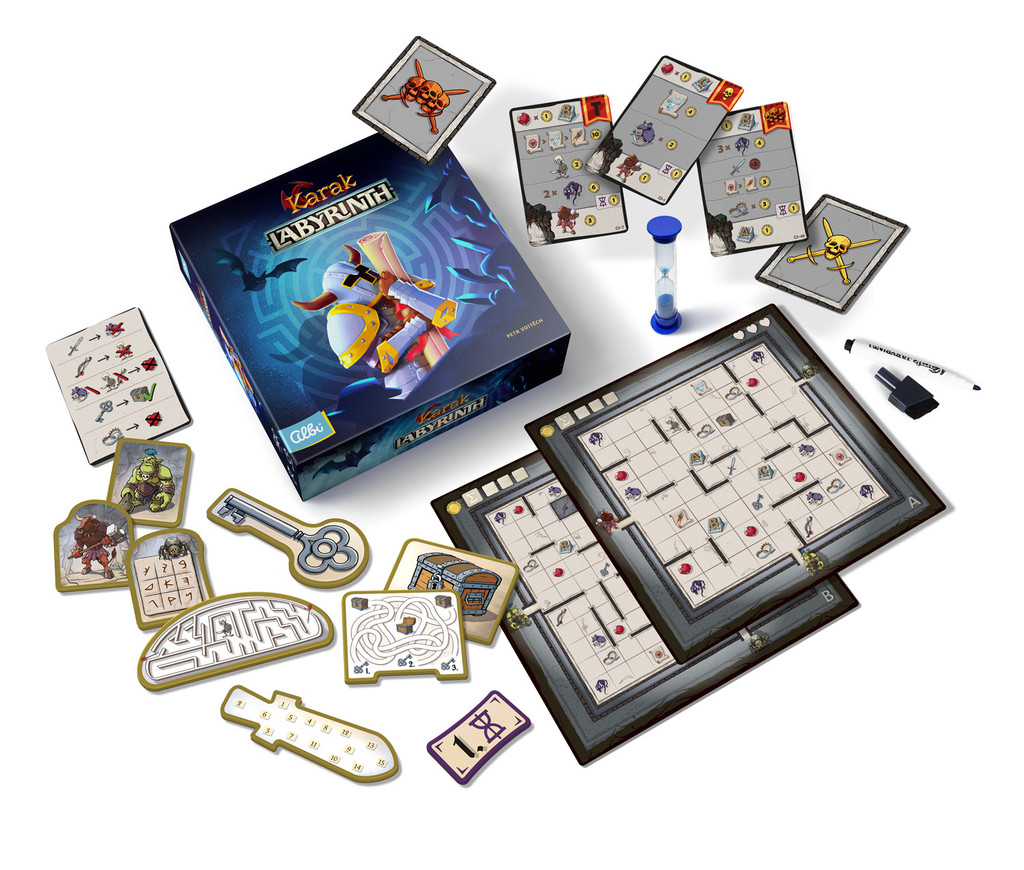
So when you find a sword in the maze, you must find an appropriate cardboard token and complete a minigame - drawing a rune on a blade in this instance. Through development we established just how many different minigames we need, and the publisher also suggested that having two sets of minigames with two levels of difficulty would be best for parents playing with kids.
There are also three difficulty levels of objective cards, and on the back side of the maze is a bigger version of the maze! Ensuring all the cards were compatible was not a trivial task. But the biggest challenge was making all the cards commensurable with the solo chart in the rulebook.
I didn't start designing the game with solo in mind, and it didn't matter whether the maximum point potential for one card was a bit higher or lower than the next. Only when we considered solo play at the end of the development, I realize all cards in one deck must be leveled so you can track and compare. And it probably makes better experience for everyone in the end.
I've seen the final production copy, and I am very happy with how it turned out. Especially playing with the thick cardboard minigames. In terms of testing and prototypes, this was the single hardest project I worked on. When precision and speed are important, testing with crappy paper in clear document sleeves was a nightmare.
Author: Petr Vojtěch – Designer of Karak: Labyrinth Photo: ALBI