
Gears of Prague Unseen
Prague Unseen is a worker placement game, where players build the spots, use different types of meeples, and play “mini-games” to score points. And the game is set in fantasy Prague. What changed? Everything in between.
- Designer diary
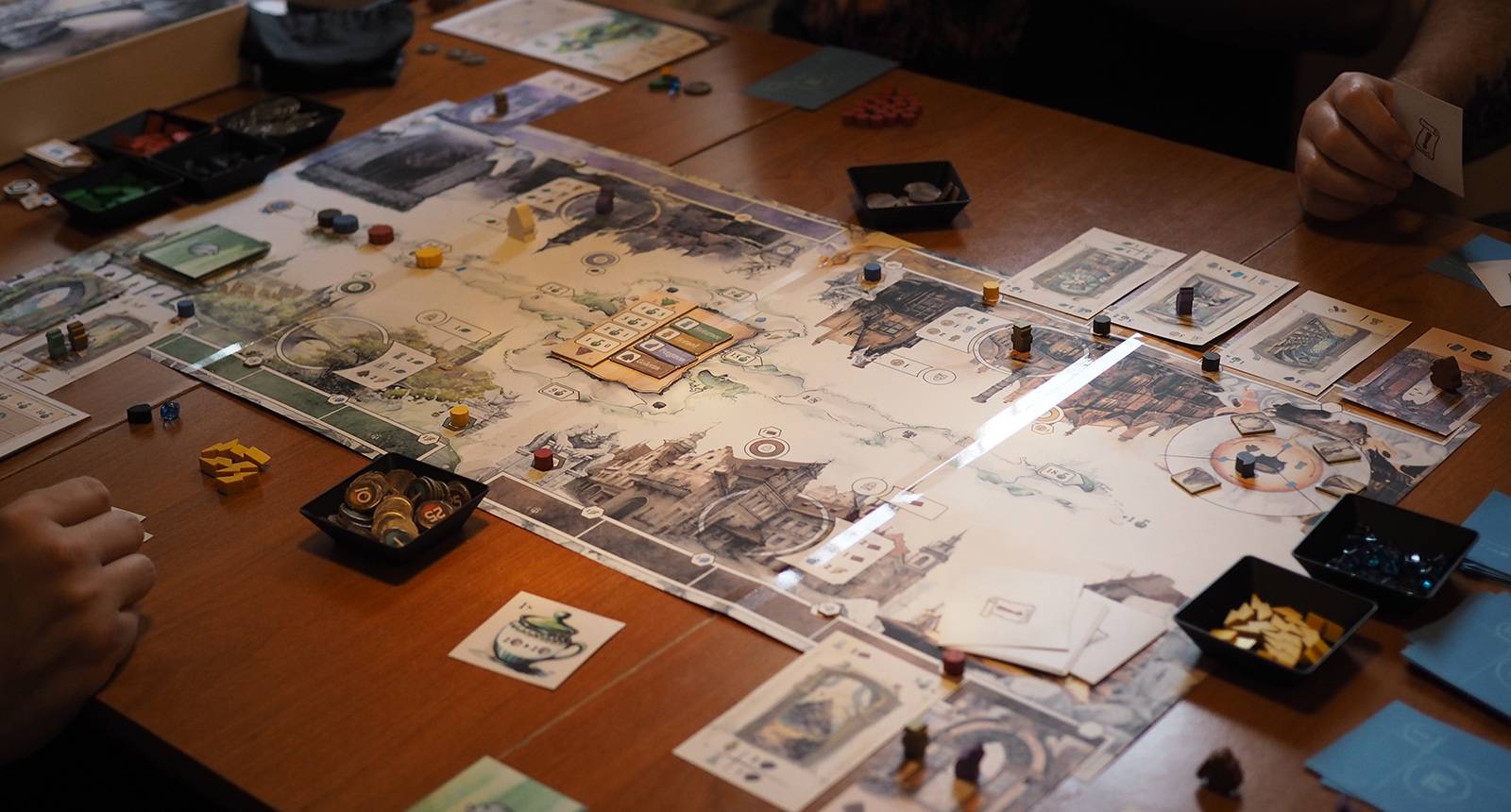
The first playtesting at Albi with the first “visual” prototype.
Petr: The minigames went through the most reworking as we tried different puzzles and mechanics. The set collection of the horned faction remained largely unchanged from the start, but every other faction changed dramatically.
How did we make and choose the minigames? We had a few strict rules. Since there are 4 different meeples in the game, the minigame must produce a different outcome for each worker. The value of the outcome may change – in both subjective and objective manner. What each meeple provides must also change over the course of the game. We also needed to balance everything so that no strategy is more fun or unbalanced in terms of generating points. Finding the right minigames was a lot of work and testing.
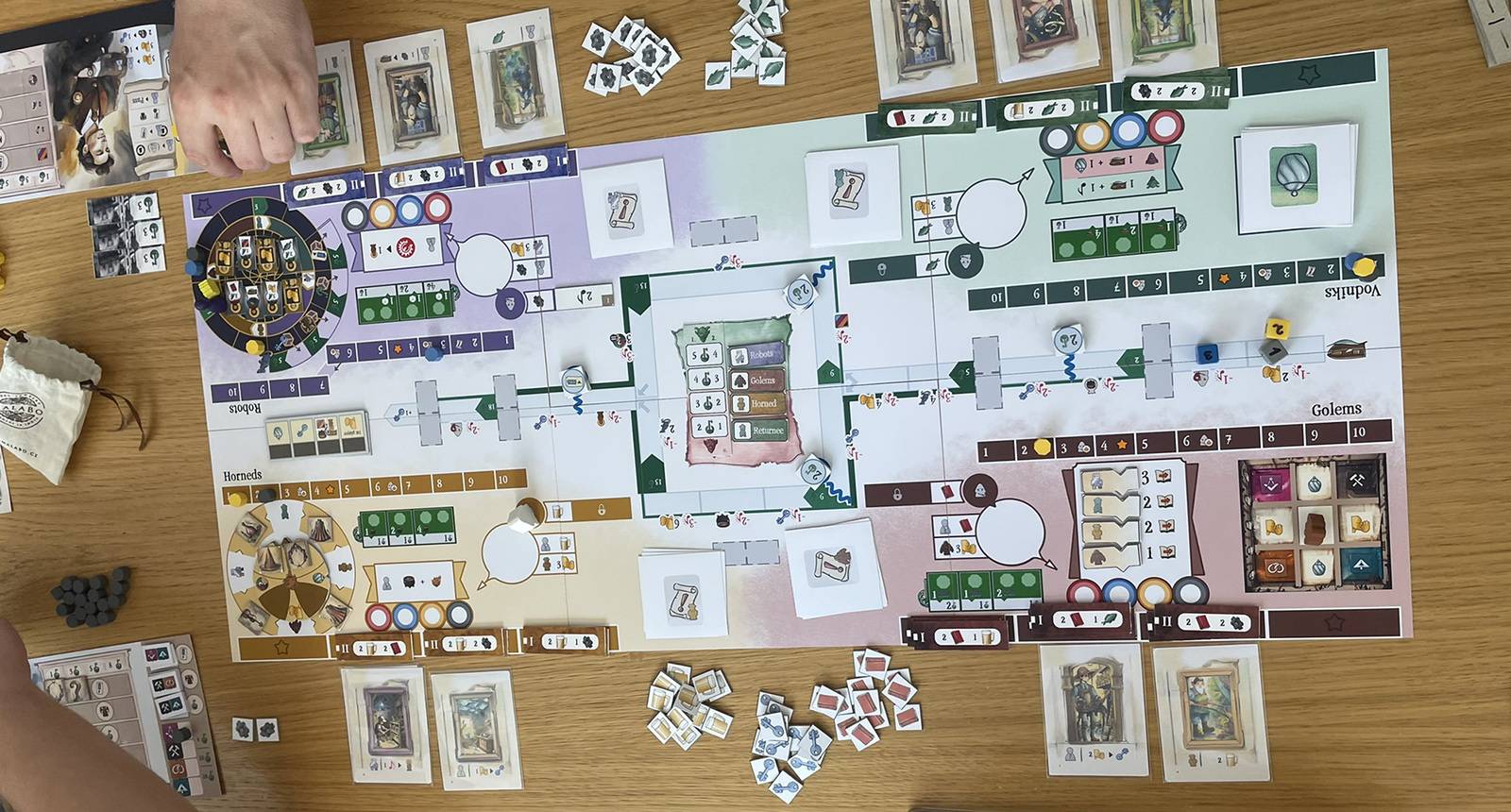
In the midst of all the design upheaval, we went back to simple graphics to iterate a bit more quickly.
From the beginning, we had only one available action: play a worker and do all the steps: check for the Witch, get resources, activate a minigame, or step on a card and maybe build a new card. When we changed it to always doing the minigame, it became way more fun. But the game slowed down a lot. We thought having a simple turn structure with only 1 available action would be good for the game, but we were wrong. What saved the game was slicing it up to 4 different actions you can choose from. And even though you may take more actions in the game than before, it’s actually quicker.
Michal: Today, the game is essentially a worker-placement game combined with set collection, tracks, influence, and several other Eurogame mechanisms.
The individual minigames went through a big number of iterations. The Vodnik’s minigame started as a simple linear track. It worked, but eventually we realized that players would simply follow the same path every time. We tried branches, alternative rewards, and several completely different approaches before arriving at the final version, where it actually depends on how clever you are to sail the river.
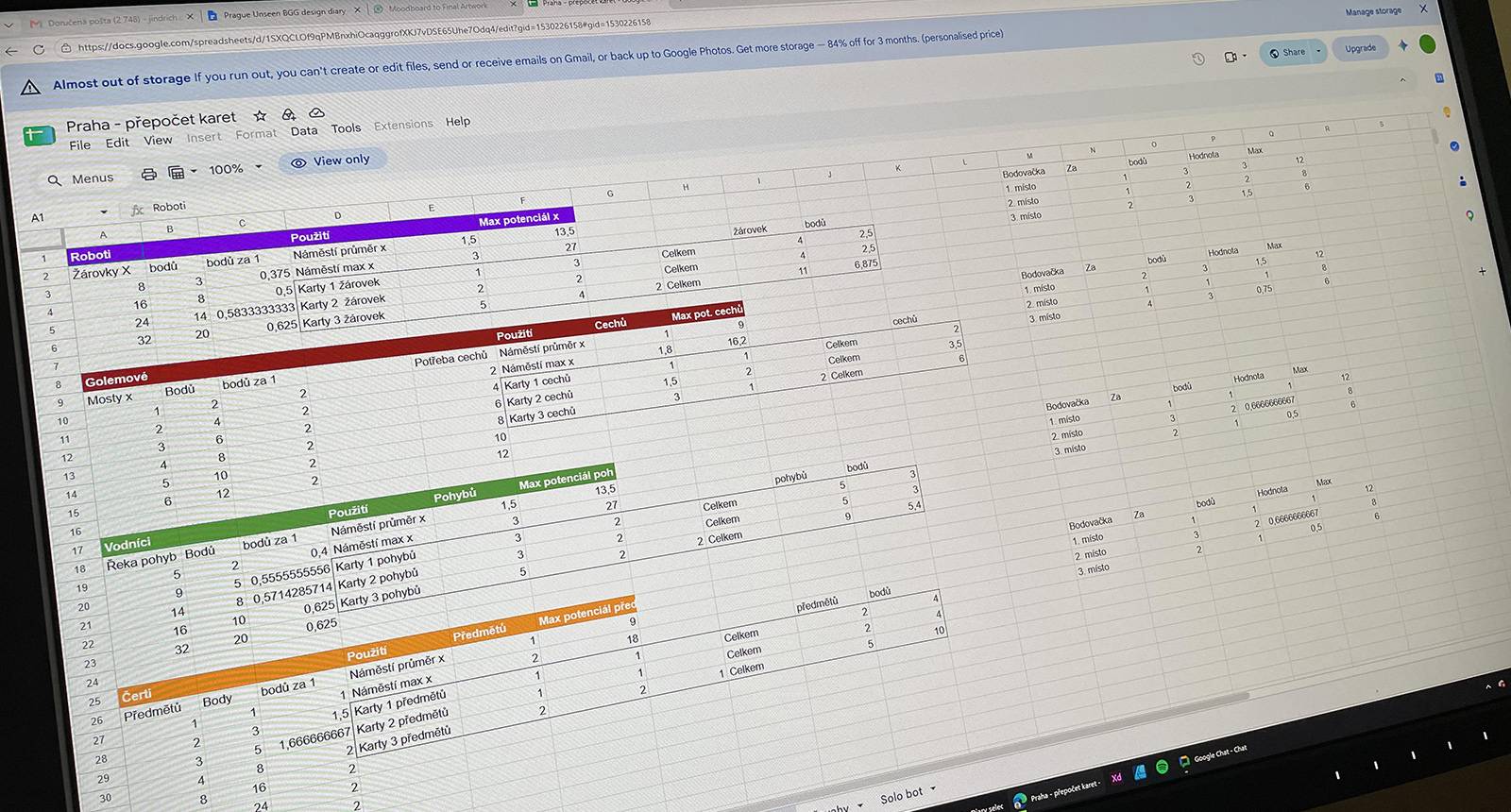
One of the spreadsheets during development
Petr: In Prague Unseen, there are several “rewards” where the value is a bit floating, so we had to set an average, or decide loosely what it should be.
Excel was necessary as the game grew. The first printed prototype didn’t have any traces of mini-games at all. Just worker-placement style spots on the board and cards. The idea was born when we decided scoring just resources and buildings wasn’t enough. We spent a lot of time balancing building cards and mini-games (in one session, testers barely took advantage of the cards they were building, while in the next, they didn’t care for our flashy mini-games).
It was when we decided you should be doing both at the same time with your meeples that it clicked. And we didn’t need to balance between 2 separate parts of the game. So we were able to focus on balancing each mini-game against the other three (I am pretty confident we did a good job, thanks to Michal setting up the spreadsheets, but you can test it for yourself).
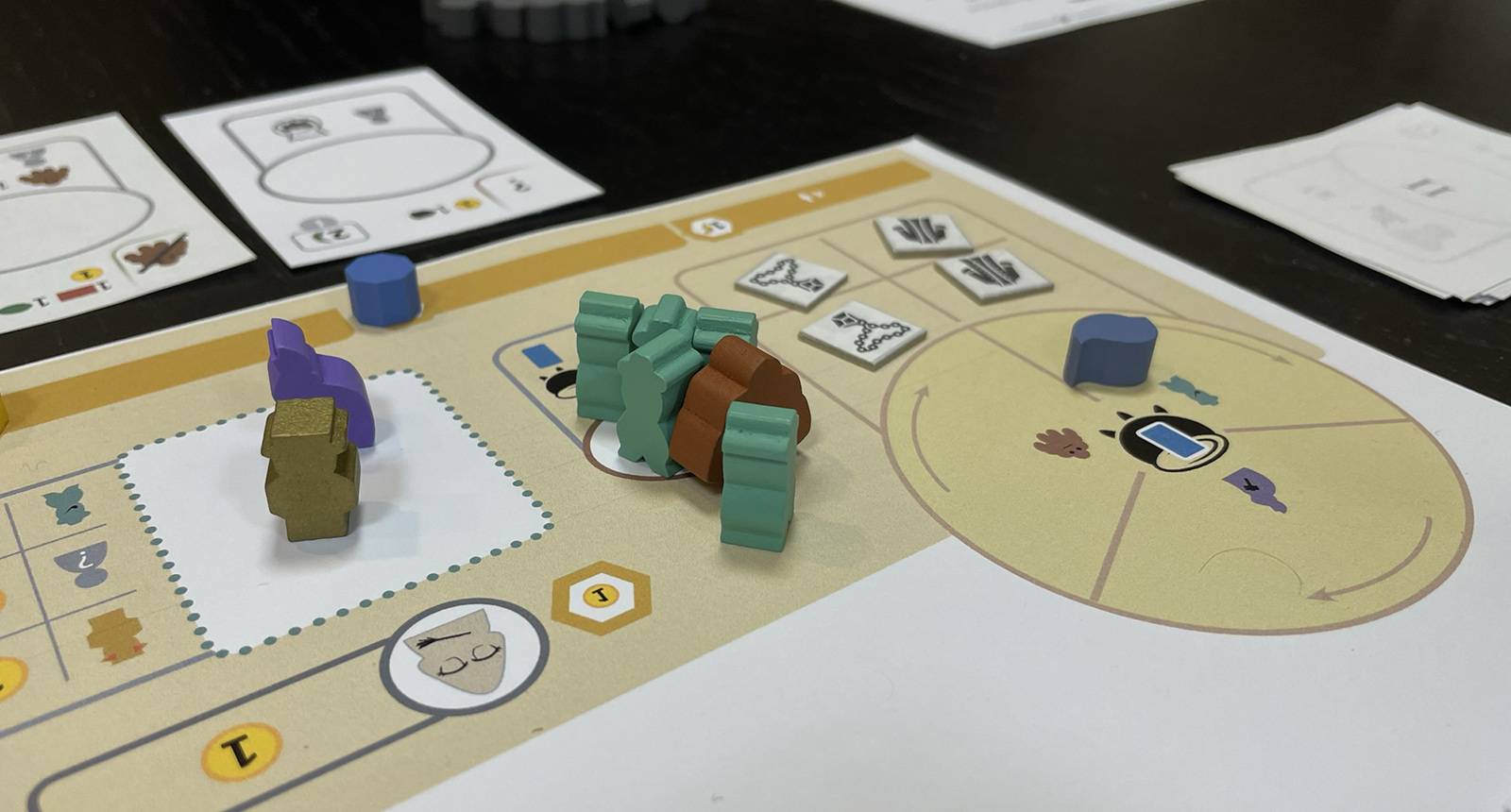
In early prototypes, you could witness workers cramped at one spot.
Petr: I love a good chunky euro, where I have a plan and try to execute it the best I can. Other players? I don’t care; my engine will beat them! But with Prague Unseen we aimed for something different. We made sure players interact on many different levels.
Competing with too many players over the same minigame will make it harder for all of you to score well. On the other hand, all of you will make sure there are spots and advantages for this very minigame, while the last player doing something completely different might struggle to boost the minigame with card presence or Witch bonuses.
At the end of each Era (there are 3 in the game), you score for presence in the neighborhoods. The players with the most influence in the neighborhood will score the points. How hard will you fight for it? Also, heavy traffic in the neighborhood will lower its score in the next Era!
But the most anxiety (in a good way!) I get when deciding when to move a worker from a neighborhood square onto a card. What I love about all this is you are actually never stopping other players from playing the game. They just need to adapt and find other ways to accomplish their goals. And usually, by doing your own thing, you open new possibilities for others as well.
Jindra: In narratology, there is a branch that describes writing not as a power-dominated process, in which the writer imposes their vision, but as an exploration of the fictional world that, in the end, yields a story that can surprise even the author. Game design, in this aspect, is the same to me. I am super happy we decided to do such player interaction, as it added a unique spark that fits well with the city full of rumors and gossip.
Authors: Michal Peichl, Petr Vojtěch, Jindřich Pavlásek Photos: Michal Peichl, Petr Vojtěch, Jindřich Pavlásek