
"Clean the cat litter boxes," says the designer of Potemkin Villages, Petr Čáslava
Potemkin Villages is a clever new cooperative trick-taking game from Albi, inspired by the famous story of a crafty prince and his deception of Empress Catherine the Great. The game is due to be released on October 22. How did designer Petr Čáslava come up with such an unusual theme? And what do cats have to do with it? You can find out in the following designer’s diary.
- Behind the Board
I remember it as if it were yesterday.
I had just finished working on the rally racing game Dirt & Dust and was slowly preparing for my next big project. However, every complex board game is a years-long undertaking and a huge commitment. Deep down, I felt that I needed a short break, but I also wanted to stay creative. As luck would have it, I came across the 2025 54-Card Game Design Contest on BoardGameGeek, and suddenly everything fell into place.
I know this is going to sound ridiculous, but I came up with the foundations of the game while cleaning cat litter boxes. Since I have several furry little creatures running around my apartment, I also have several litter boxes, and it takes a while to clean each one properly.
THE FIRST CAT LITTER BOX
As I started sifting through the litter, I realized that I wanted to make a trick-taking game. It’s my favorite card game mechanism, and it’s so well-defined that I thought it wouldn’t have to be such a huge amount of work. It also seemed like a great fit for the 54-Card Game Design Contest. Shortly afterwards, I decided that I wanted the game to be cooperative, because cooperative games are generally easier to design, and you can avoid the annoying task of balancing everything in Excel spreadsheets.
THE SECOND CAT LITTER BOX
This was where I paused for a moment. Not because I had discovered anything surprising in the litter, but because I was trying to figure out what would make my trick-taking game interesting. I still wanted it to be a relatively clean and simple design. Eventually, I decided that the easiest solution would be for each player to have a special ability that would activate every time they won a trick. That seemed simple enough, while also giving me a clearly defined space in which I could do my creative work.
THE THIRD CAT LITTER BOX
And that was the problem of the third litter box. I was slowly sifting through the litter and couldn’t figure out what those abilities should actually do. Then I found a really huge clump and thought to myself: “Petr… you can’t have anything in the game other than cards. So those cards have to lie on the table, and the players have to manipulate them somehow.” Into the bag went the clump. “But what do those cards actually represent? Wow… that’s a really big turd. That’s a turd the size of a house. Hmm… house…”
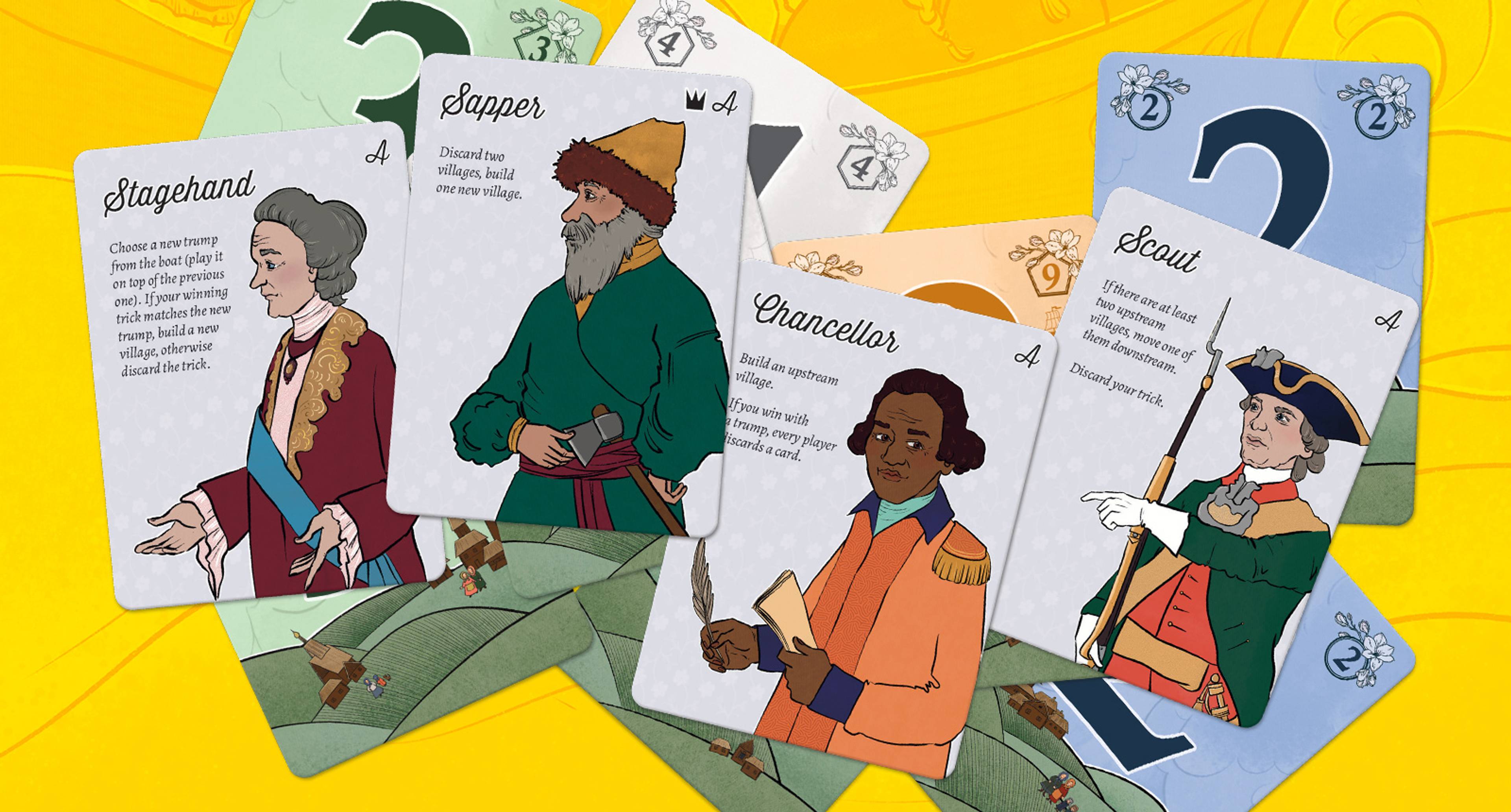
Once I found the theme for my game – Potemkin Villages – everything moved pretty quickly. I liked the idea of having cards on the table representing fake villages, with Catherine the Great sailing toward Crimea alongside them. That very evening, I designed the first four abilities for the characters players could take on.
THE DOUBLE (TRIPLE) MATRIX PROBLEM
From the beginning, I wanted to encourage strong cooperation between the players. So I designed the characters in such a way that they would need one another. I also divided them by role into those with supportive effects and those whose abilities would directly alter the course of the game. This created theoretical connections between the characters. All that remained was to build the design so that the characters would come into play at the right times.
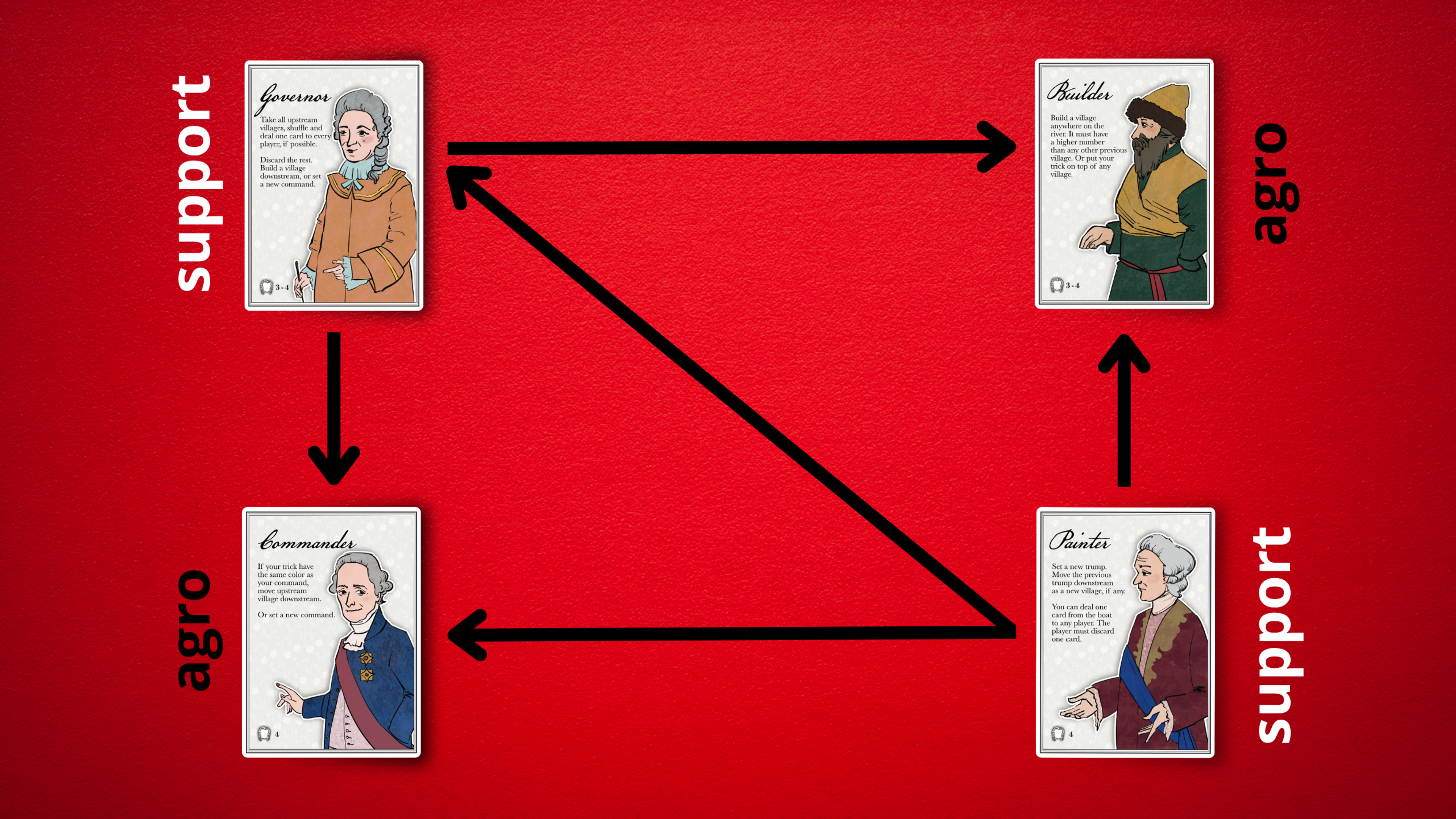
The problem is that if you make one character’s effect really powerful, you risk players trying to make that character win every trick. That’s something that belongs to trick-taking games to some extent, but I wanted the characters to be involved more evenly, and for even those whose primary role was to support the others to want to win a trick at certain specific moments.
So, in addition to trying to design the characters’ abilities so that they would interact with one another, I also tried to distribute their roles evenly and place everything along a timeline, giving each character its own “action window.”
And somewhere along the way, I realized that my attempt to make a simple little game just for fun had, in fact, turned into something pretty crazy.
2025 54-CARD GAME DESIGN CONTEST
To enter the contest, I needed to give the game a proper visual identity. Ekatěrina Bystroň took care of that entirely free of charge. What’s more, I liked her illustrations so much that I decided that if the game ever received an official release, I wouldn’t look for another illustrator. I would rather pay Ekatěrina in full for everything she deserved.
And while I’m talking about Ekatěrina, I also have to mention Ondřej Bystroň (co-designer of Kutná Hora – editor’s note), who was a huge support to me throughout the entire development process and diligently playtested the early versions of the game with me. Without him, Potemkin Villages probably would never have existed.
I submitted the game to the contest at the very last minute. There’s probably no point in saying that this is a pretty bad idea, because if you want to get people’s attention, you need to give it some time. But I wasn’t expecting much anyway, so I simply uploaded it to the site and used social media to let my followers know that they could download my new game for free.
Then something incredible happened. Hundreds of people downloaded the original file. Quite a few of them started writing to me, saying that they were playing the game and really enjoying it. I was completely blown away. I hadn’t expected it at all. The game hadn’t been fully playtested, the rules were full of holes, and I’m sure there were plenty of things that simply didn’t make sense.
That made it all the more surprising when the game won third place for Best Cooperative Game, third place for Best Overall Game, and second place for Best Illustrations. To be honest, the last one didn’t surprise me quite as much.
WHAT CAME NEXT
After the contest ended, I realized that I had “something.” Publishers started calling me, I arranged meetings, and I demonstrated the game at various events. Eventually, I reached an agreement with Albi to publish the game. What was great was that they were determined to release it already this year, which was important to me.
At the same time, I knew it was a commitment, because for a full-fledged release I wanted to thoroughly playtest and refine the original four characters and design at least two more sets – twelve unique characters in total.
In the end, I stopped at sixteen, because the game turned out to be quite challenging, and we also wanted a set of characters for complete beginners, so that people could ease themselves into the game more easily.
It was quite a ride, but the game gives me an incredible amount of joy. And most importantly, I finally fulfilled a long-held dream: I designed my very own trick-taking card game!
Author: Petr Čáslava FPhoto by ALBI